The Tradition Gravity
Could Not Break
墨西哥的建设性左翼:
三次实验
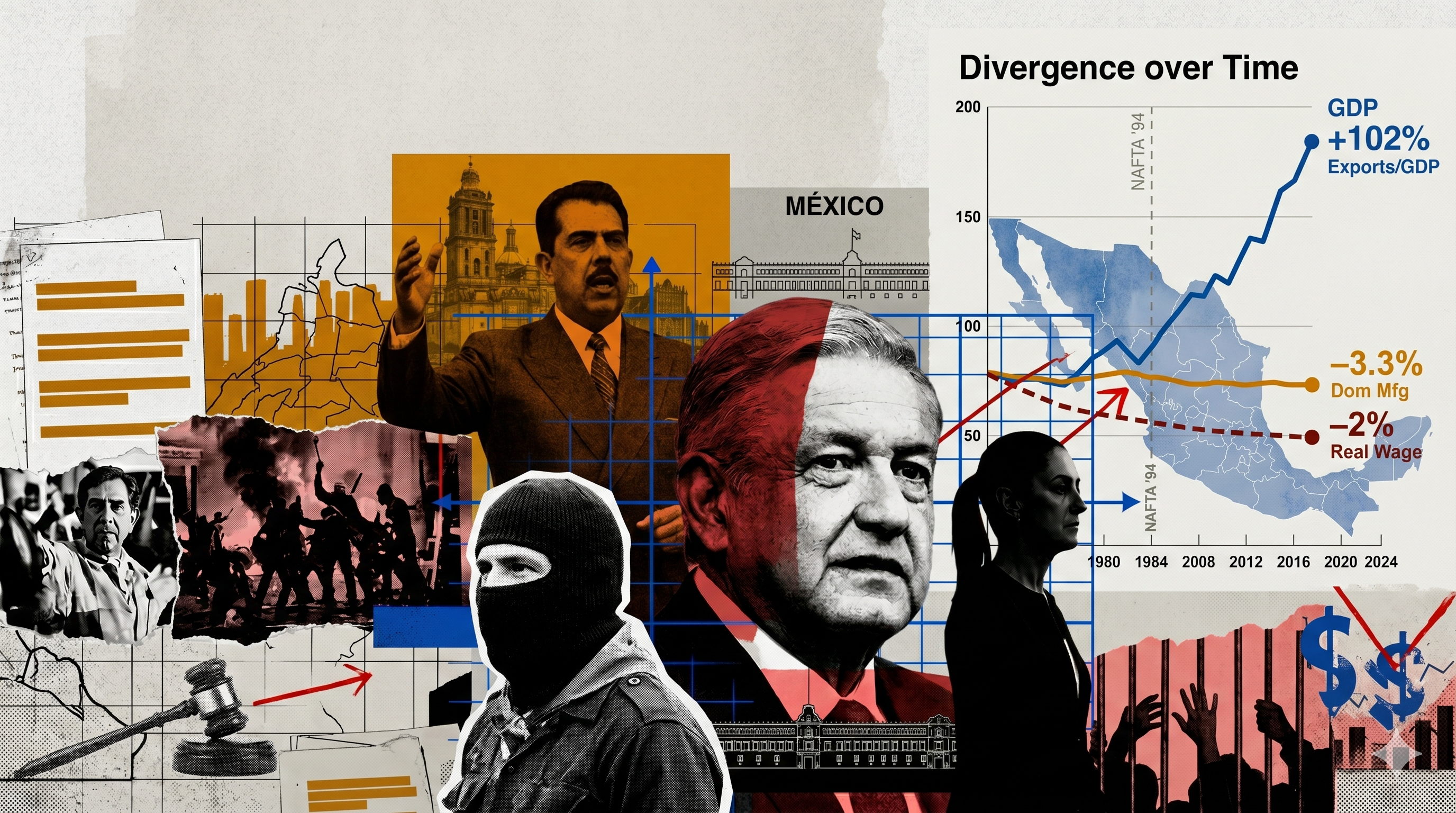
Mexico's inequalities are not explained by the absence of a reform tradition. In the twentieth and twenty-first centuries, three distinct, historically serious attempts to build a different Mexico have been made — from above, from below, and through electoral democracy. Each produced real, measurable gains for the poor and dispossessed. None broke the structural architecture that defines the country's political economy. Together, they constitute a living tradition whose defeats are not evidence of weakness but of the structural depth of the forces it has not yet overcome. 墨西哥的不平等不能用改革传统的缺失来解释。在二十世纪和二十一世纪,三次截然不同、历史上严肃的构建不同墨西哥的尝试已经发生——从上而下、从下而上,以及通过选举民主。每次都为穷人和被剥夺者带来了真实的、可衡量的收益。没有一次打破了定义该国政治经济的结构架构。合在一起,它们构成了一个活的传统,其失败不是软弱的证据,而是它尚未克服的力量的结构深度的证据。
No amo mi patria. Su fulgor abstracto es inasible. Pero (aunque suene mal) daría la vida por diez lugares suyos, cierta gente, puertos, bosques de pinos, fortalezas, una ciudad deshecha, gris, monstruosa, varias figuras de su historia, montañas —y tres o cuatro ríos.
I do not love my country. Its abstract brilliance is beyond my grasp. But (though it may sound wrong) I would give my life for ten of its places, certain people, ports, pine forests, fortresses, a ruined city, gray, monstrous, various figures from its history, mountains —and three or four rivers.我不爱我的祖国。 它抽象的光辉,让我无从把握。 但(尽管听来突兀) 我愿以生命相许 只为它的十个地方,某些人, 港口、松树林、要塞, 一座残破的、灰色的、怪兽般的城市, 历史上的几个人物,山脉 ——还有三四条河流。
The demand that has never died: a Mexico that belongs to those who work it. 从未消亡的诉求:一个属于耕种它之人的墨西哥。
The Mexican Revolution of 1910–1920 did not produce a socialist state. It produced something more complex: a constitutional settlement in which the most radical demands of the revolutionary period were encoded as institutional possibilities — land redistribution, resource nationalization, social rights — without any guarantee that those possibilities would be realized. The 1917 Constitution was simultaneously the most radical in the Western Hemisphere and a document whose principal achievements were potential rather than actual. 1910至1920年的墨西哥革命没有产生社会主义国家。它产生了更复杂的东西:一种宪法解决方案,在其中,革命时期最激进的诉求——土地再分配、资源国有化、社会权利——被编码为制度可能性,而没有任何这些可能性将被实现的保证。1917年宪法同时是西半球最激进的宪法,也是其主要成就是潜在的而非实际的文件。
That gap between constitutional possibility and structural reality became the permanent terrain of Mexican reform politics. Three times in the century that followed, political actors with genuine social bases attempted to close the gap through fundamentally different methods. The stories of Cárdenas, the Zapatistas, and AMLO are not three independent events. They are three movements within the same long composition — the same demand, the same structural adversaries, three distinct tactical gambles on which method of transformation could actually work. 宪法可能性与结构现实之间的差距成为了墨西哥改革政治的永久地形。在随后的世纪里,三次具有真正社会基础的政治行动者通过根本不同的方法试图弥合这一差距。卡德纳斯、萨帕塔运动和AMLO的故事不是三个独立事件。它们是同一部漫长乐章中的三个乐章——同一个诉求,同一些结构性对手,三次截然不同的关于哪种转型方法可以真正奏效的战术赌注。
Each experiment began with a material grievance that the constitutional text explicitly promised to address. Each constructed an institutional form to carry the demand: the ejido and the nationalized company; the autonomous community and the caracol; the electoral majority and the federal budget. Each produced real gains. Each was eventually absorbed, bypassed, or reversed by the structural forces that the Constitution's framers had also encoded into the document. The tradition is not a story of failure; it is a story of contained success. 每次实验都始于宪法文本明确承诺要解决的物质诉求。每次都构建了一种承载诉求的制度形式:ejido和国有公司;自治社区和caracol;选举多数和联邦预算。每次都带来了真实的收益。每次最终都被宪法起草者也编码到文件中的结构性力量所吸收、绕过或逆转。这个传统不是一个失败的故事;它是一个被遏制的成功的故事。
The Three Methods at a Glance三种方法一览
| Experiment实验 | Method方法 | Terrain地形 |
|---|---|---|
| Cárdenas 1934–40 |
Executive state power行政国家权力 | Rural ejido, oil fields, military institutions农村ejido、油田、军事制度 |
| Zapatistas萨帕塔运动 1994– |
Autonomous civil society自治公民社会 | Indigenous Chiapas, international solidarity networks土著恰帕斯州、国际声援网络 |
| AMLO 2018–24 |
Electoral majority + federal budget选举多数+联邦预算 | National politics, transfer programs, wage floor国家政治、转移项目、工资底线 |
Perry Anderson's framing for Latin American reformers: "objective empathy" — understanding a political figure's genuine achievements and genuine constraints together, without collapsing into either apologia or denunciation. Applied here: each experiment is analyzed on its own terms, with full acknowledgment of material gains and structural failures. The goal is not to adjudicate their moral legitimacy but to understand why structurally serious attempts at transformation in Mexico have consistently produced partial success. 佩里·安德森对拉美改革者的框架:"客观同理心"——同时理解一个政治人物的真实成就和真实限制,不陷入辩护或谴责。在此应用:每次实验按其自身条件分析,充分承认物质收益和结构性失败。目标不是裁定其道德合法性,而是理解为什么墨西哥结构上严肃的转型尝试始终产生局部成功。
Anderson's method has a cultural analogue in Mexico's own intellectual tradition. Octavio Paz's Laberinto de la Soledad (1950) named the psychic inheritance of conquest and revolution before social science had the vocabulary. Jorge Castañeda's Mañana Forever (2011) catalogued the cultural dispositions — distrust of institutions, preference for private over public life, the logic of the vivo — that structural reformers have always had to work against. The resulting tradition of intellectual self-reckoning is unusually coherent: a continuous, often brutal national conversation about why Mexico is the way it is, conducted across poetry, murals, novels, and essays for over a century. The reform tradition analyzed here is its political expression. The literary tradition — Paz, Pacheco, the muralists — is its cultural substrate. Both are more serious than anything comparable in most of Mexico's peers. 安德森的方法在墨西哥自身的知识传统中有其文化对应物。帕斯的《孤独的迷宫》(1950年)在社会科学尚无词汇之前,便已命名了征服与革命留给墨西哥的心理遗产。卡斯塔内达的《永远的明天》(2011年)梳理了结构性改革者始终不得不与之周旋的文化特质——对制度的不信任、私人领域优先于公共生活的倾向、"精明者"(vivo)的生存逻辑。由此形成的知识自省传统格外连贯:一场跨越诗歌、壁画、小说与散文、延续百余年的持续而往往残酷的国家自我对话。此处分析的改革传统是其政治表达。文学传统——帕斯、帕切科、壁画家们——是其文化基底。两者的严肃程度都超过墨西哥大多数同类国家的可比传统。
Lázaro Cárdenas: the six years that changed the ground beneath everything else. 拉萨罗·卡德纳斯:改变了所有其他一切之基础的六年。
Lázaro Cárdenas entered the presidency in 1934 as a PRM party figure — a loyal, low-key general from Michoacán who had spent his career in PRI's predecessor structures. What he became in office was something the party apparatus had not anticipated: the most transformative executive in Mexico's modern history, and the most effective at dismantling the structural privileges that the revolution had nominally targeted. 拉萨罗·卡德纳斯于1934年以PRM党内人物身份就任总统——一位来自米却肯州的忠诚、低调的将军,一生都在PRI前身机构中度过。他在任期内成为党机器所没有预料到的东西:墨西哥现代史上转型能力最强的行政长官,也是最有效地拆除革命名义上所针对的结构性特权的人。
The land reform. Before Cárdenas, all presidents from 1917 to 1934 combined had distributed approximately 9 million hectares to rural communities — impressive in absolute terms, inadequate as a fraction of the 97% of productive land still controlled by the latifundista class. In six years, Cárdenas distributed 18 million hectares — more than the sum of every previous administration — to approximately 800,000 farming families. In the sugar-producing Morelos, the cotton zones of Laguna, the henequen plantations of Yucatán, and the wheat fields of Sonora, entire estate systems were expropriated and reconstituted as collective ejidos. Cárdenas understood that the ejido was not primarily an agricultural productivity instrument. It was a structural check on the reconcentration of land. 土地改革。在卡德纳斯之前,1917至1934年间所有总统总共向农村社区分配了约900万公顷土地——以绝对数量而言令人印象深刻,但作为仍由大庄园主阶级控制的97%生产性土地的比例来说远远不够。在六年间,卡德纳斯向约80万农户家庭分配了1800万公顷——超过所有之前政府的总和。在莫雷洛斯的甘蔗产区、拉古纳的棉花地带、尤卡坦的龙舌兰种植园和索诺拉的小麦田,整个庄园体系被征收并重组为集体ejido。卡德纳斯理解ejido首先不是农业生产率工具。它是防止土地再集中的结构性制衡。
The oil nationalization. On March 18, 1938, Cárdenas announced the expropriation of 17 foreign oil companies — including Standard Oil of New Jersey and Royal Dutch Shell — into a newly created state company, Petróleos Mexicanos (Pemex). The legal basis was a labor dispute in which the Supreme Court had ruled in the workers' favor; the oil companies refused to comply; Cárdenas nationalized them. What followed was unprecedented in Mexican political history: a spontaneous nationwide response in which ordinary citizens — indigenous communities, schoolteachers, factory workers, elderly women — donated jewelry, livestock, and savings to a government account to pay the nationalization indemnity. The Mexican archbishop called it a patriotic duty. The state received a domestic legitimacy surplus it would draw on for decades. 石油国有化。1938年3月18日,卡德纳斯宣布将17家外国石油公司——包括新泽西标准石油和荷兰皇家壳牌——征收并入新成立的国家公司墨西哥石油(Pemex)。法律依据是一场劳资纠纷,最高法院已裁定支持工人;石油公司拒绝遵守;卡德纳斯将其国有化。随后发生的是墨西哥政治史上前所未有的事:一场自发的全国性回应,普通公民——土著社区、小学教师、工厂工人、年迈妇女——向政府账户捐赠珠宝、牲畜和储蓄以支付国有化赔偿金。墨西哥大主教称之为爱国义务。国家获得了将使用数十年的国内合法性盈余。
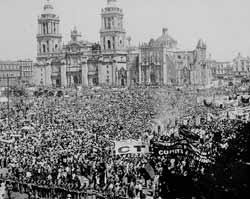
Cárdenas broadcast the nationalization on live national radio in a voice reporters described as "controlled but visibly moved." By the following morning, the spontaneous national collection had begun. Indigenous communities drove livestock to government offices. Factory workers donated a week's wages. Schoolteachers emptied savings accounts. Elderly women arrived at tax collection offices carrying rings, necklaces, and bracelets — wedding jewelry — and laid them on the counter.卡德纳斯通过全国直播电台宣布国有化,记者形容他"克制但明显激动"。第二天早晨,自发的全国捐款开始了。土著社区将牲畜赶到政府办公室。工厂工人捐出一周工资。小学教师清空储蓄账户。年迈的妇女拿着戒指、项链和手镯——结婚时收到的珠宝——走进税务办公室,放在柜台上。
A widow in Veracruz told the press she had nothing more valuable to give than her wedding ring. The popular donations — chickens, cattle, gold — covered only a fraction of the $23M USD indemnity eventually paid. But the image of ordinary Mexicans paying in kind for national sovereignty became the founding myth of Pemex, and the basis of the Mexican state's claim to represent the pueblo against foreign capital. Cárdenas drew on that legitimacy surplus for the rest of his political life.韦拉克鲁斯一位寡妇告诉媒体,她没有比结婚戒指更宝贵的东西可以捐出了。民众捐赠——母鸡、牛只、黄金——仅覆盖了最终支付的2300万美元赔偿金的一小部分。但普通墨西哥人以实物为国家主权买单的形象,成为Pemex的建国神话,以及墨西哥国家代表人民对抗外国资本之主张的基础。卡德纳斯在余下的政治生涯中一直依赖这一合法性盈余。
"We shall, if necessary, sacrifice all the constructive projects on which the Nation has embarked in order to cope with the financial obligations imposed upon us. I ask the entire nation for sufficient moral and material support to carry out a resolution so justified, so transcendent, and so indispensable.""如有必要,我们将牺牲这届政府任期内国家已着手的所有建设性工程,以履行这些财务义务。我请求整个国家给予足够的道义和物质支持,以推行这一如此正当、如此深远、如此不可或缺的决议。"
— Lázaro Cárdenas, radio address, March 18, 1938— 拉萨罗·卡德纳斯,全国广播,1938年3月18日
The military demilitarization. Cárdenas' least-discussed but most durable institutional achievement was the removal of the military from party politics. He restructured the ruling PRM party to include four "sectors" — peasants, workers, popular organizations, and the military — but systematically transferred political decision-making power to the civilian sectors. When he established the PRI in 1946 under his successor Ávila Camacho, the military sector was eliminated entirely. Mexico became one of the few countries in Latin American history where the armed forces have not staged a coup since the formalization of civilian control. That structural inheritance — the demilitarized army — was the institutional precondition that would allow AMLO, eighty years later, to hand the military operational control of civilian infrastructure without fear of political blowback. 军队非政治化。卡德纳斯最少被讨论但最持久的制度成就是将军队从党政中移除。他将执政的PRM党重组为四个"扇区"——农民、工人、民众组织和军队——但系统性地将政治决策权转移给了文官扇区。当他在继任者阿维拉·卡马乔领导下于1946年建立PRI时,军队扇区被完全取消。墨西哥成为拉美历史上少数几个自文官控制正式化以来武装部队未发动政变的国家之一。这一结构性遗产——非政治化的军队——是制度前提,将使AMLO八十年后能够将军队对文官基础设施的运营控制权移交,而无需担心政治反弹。

Land Reform Context: What Was Distributed vs. What Wasn't土地改革背景:分配了什么,未分配什么
| Period时期 | Area Distributed分配面积 | Share of National Territory全国领土占比 |
|---|---|---|
| All presidents 1917–19341917–1934所有总统 | ~9M ha | 4.6% |
| Cárdenas alone (1934–40) | ~18M ha | 9.2% |
| Cumulative by 19401940年累计 | ~27M ha | 13.8% |
| Final ejido/comunidad total (1992)最终ejido/社区总计(1992) | ~100M ha | ~51% |
Note: The best-quality irrigated plains were largely protected by a 100-hectare exemption in Art. 27. Cárdenas distributed more land than any predecessor — but not the highest-value land.注:最优质的灌溉平原在很大程度上受到第27条100公顷豁免的保护。卡德纳斯分配的土地比任何前任都多——但不是最高价值的土地。
Cárdenas' Structural Limits卡德纳斯的结构性局限
Why Cárdenas remained the benchmark: He is the only figure in Mexico's postcolonial history who simultaneously undertook land redistribution at scale, resource nationalization, and the institutional subordination of the military to civilian authority — and completed all three without being overthrown, assassinated, or forced into exile. His demilitarization achievement is his most underappreciated: in a hemisphere where army coups remained standard political currency through the 1980s, Cárdenas placed the Mexican military in a civilian cage in 1946 and it has stayed there. AMLO, describing himself as a "Cardenista," was not claiming an empty rhetorical inheritance. He was invoking the specific institutional architecture that made his own election and presidency structurally possible. 为什么卡德纳斯仍是基准:他是墨西哥后殖民历史上唯一同时大规模推行土地再分配、资源国有化,以及军队在制度上服从文官权威的人物——并且在不被推翻、暗杀或被迫流亡的情况下完成了这三项。他的非军事化成就是他最被低估的:在整个80年代军事政变仍是标准政治货币的半球里,卡德纳斯于1946年将墨西哥军队关进文官牢笼,它就一直在那里待着。AMLO称自己为"卡德纳斯主义者",不是在宣称一种空洞的修辞遗产。他在援引使他自己的选举和总统任期在结构上成为可能的具体制度架构。
The Zapatista Uprising: dignified rebellion, autonomous community, and the world that NAFTA made. 萨帕塔起义:有尊严的反抗、自治社区,以及NAFTA造就的世界。
The EZLN uprising was not a surprise to the Mexican government. Intelligence services had monitored indigenous community organizing in the Chiapas highlands for years. What the government had not anticipated was the political intelligence of the insurgent leadership — in particular the figure of Subcomandante Marcos, who would transform what began as a guerrilla military operation into something the late twentieth century had no adequate framework to describe: simultaneously a local land rights struggle, an anti-neoliberal critique, a democratic constitutional movement, and the world's first politically successful internet-mediated insurgency. EZLN起义对墨西哥政府来说并不意外。情报机构多年来一直监视恰帕斯高地的土著社区组织活动。政府没有预料到的是起义领导层的政治智慧——特别是副指挥官马科斯这一人物,他将一场从军事游击行动开始的运动转变为二十世纪末没有适当框架描述的东西:同时是一场本地土地权利斗争、一种反新自由主义批判、一场民主宪政运动,以及世界上第一次政治上成功的互联网中介起义。
The causes. The Zapatistas' grievances were three simultaneous blows: (1) the 1992 Salinas constitutional reform that ended ejido protections and allowed indigenous communal land to be privatized; (2) the NAFTA corn shock that would destroy the economic basis of subsistence farming in the country's poorest indigenous communities; and (3) six centuries of colonial and post-colonial dispossession that the 1917 Constitution had promised to address but the Mexican state had consistently used as political theater rather than actual policy. The uprising was the answer to the sentence: "Not even this, not even what you promised on paper." 起因。萨帕塔运动的诉求是三个同时发生的打击:(1)1992年萨利纳斯宪法改革,终止了ejido保护并允许土著集体土地被私有化;(2)将摧毁该国最贫穷土著社区自给农业经济基础的NAFTA玉米冲击;以及(3)六个世纪的殖民和后殖民剥夺,1917年宪法曾承诺解决,但墨西哥国家始终将其作为政治剧场而非实际政策。起义是对这句话的回答:"连这个都没有,连你们白纸黑字承诺的都没有。"
What they built. After twelve days of urban occupation and a government ceasefire, the EZLN did not demobilize. They negotiated — the San Andrés Accords of 1996 represented a genuine legal framework for indigenous autonomy that the Zedillo government signed and then refused to implement. In response, the Zapatistas simply built their autonomous institutions anyway, outside and despite the state. The caracoles — five regional administrative centers managing health, education, justice, and agriculture — governed approximately 300,000 people in the Chiapas highlands by the 2010s. Their health system outperformed the state system in their territories. Their schools, taught in indigenous languages, were operating for three decades before the Mexican state recognized bilingual education as a right. 他们所建造的。在十二天城市占领和政府停火后,EZLN没有复员。他们进行了谈判——1996年的《圣安德烈斯协议》代表了土著自治的真正法律框架,塞迪略政府签署后拒绝执行。作为回应,萨帕塔运动干脆无论如何在国家之外、尽管有国家的情况下建立了他们的自治机构。到2010年代,caracoles——管理卫生、教育、司法和农业的五个地区行政中心——治理着恰帕斯高地约30万人。他们的卫生系统在其领土上优于国家系统。他们用土著语言教学的学校运营了三十年,然后墨西哥国家才承认双语教育是一项权利。
The networked insurgency. The Zapatistas' global influence vastly exceeded their military or territorial power. Marcos' communiqués — witty, literary, philosophically sophisticated — were distributed through the early internet by solidarity networks before the mainstream press could reproduce them. The January 1994 uprising generated a global solidarity movement that constrained the Mexican government's military options and secured the ceasefire within days. The EZLN became the reference point for the anti-globalization movement of 1999–2003, and the theoretical vocabulary they developed around horizontal democracy, indigenous rights, and dignified autonomy shaped a generation of social movements on five continents. What the Zapatistas proved is that a sub-national, resource-poor, militarily marginal movement could generate global political effects through information asymmetry. This was a genuinely new discovery in the history of insurgency. 网络化起义。萨帕塔运动的全球影响远超其军事或领土力量。马科斯的声明——机智、文学性、哲学上精致——在主流媒体能够转载之前,就通过声援网络在早期互联网上传播。1994年1月的起义激起了全球声援运动,在短短几天内约束了墨西哥政府的军事选项并确保了停火。EZLN成为1999至2003年反全球化运动的参照点,他们围绕水平民主、土著权利和有尊严自治所发展的理论词汇塑造了五大洲一代社会运动。萨帕塔运动所证明的是,一个次国家的、资源匮乏的、军事上处于边缘的运动可以通过信息不对称产生全球政治效果。这是起义历史上一个真正新颖的发现。
Key Dates — A Long Insurgency关键日期 — 漫长的起义
Autonomous Governance — What Was Actually Built自治治理——实际建造了什么
| Domain领域 | Achievement成就 |
|---|---|
| Health卫生 | ~45 community clinics; lower infant mortality in autonomous zones than state-administered areas约45个社区诊所;自治区婴儿死亡率低于国家管辖区域 |
| Education教育 | ~500 autonomous schools teaching in Tzeltal, Tzotzil, Tojolabal; literacy rates improved约500所学校以泽尔托语、佐佐语、托霍拉巴尔语教学;识字率提升 |
| Justice司法 | Juntas de Buen Gobierno handle disputes without state courts; restorative justice model良政委员会在无国家法院情况下处理纠纷;恢复性司法模式 |
| Territory领土 | ~300K people in ~1,000 communities; persistent military encirclement; no formal legal status约30万人在约1000个社区;持续军事包围;无正式法律地位 |
The Faces of the Uprising起义的面孔


The Zapatistas' theoretical contribution to world politics: They coined the concept of "dignified rebellion" (rebeldía digna) — a politics that does not seek state power but constructs democratic autonomy outside it. Their framing of the goal as "a world where many worlds fit" (un mundo donde quepan muchos mundos) anticipated the theoretical preoccupations of global social movements by a decade. Their rejection of AMLO in 2018 — explicitly refusing to support the most left-wing presidential candidate in thirty years — was not political error. It was the logical conclusion of their analysis: the problem is not who holds the federal executive, but what the federal executive can structurally do. Their thirty-year existence as autonomous communities is the most sustained experiment in post-state democratic governance in the Western Hemisphere. 萨帕塔运动对世界政治的理论贡献:他们创造了"有尊严的反抗"(rebeldía digna)概念——一种不寻求国家权力而是在其之外构建民主自治的政治。他们将目标表述为"一个许多世界都能容纳其中的世界"(un mundo donde quepan muchos mundos),提前了全球社会运动的理论关切十年。他们在2018年拒绝AMLO——明确拒绝支持三十年来最左翼的总统候选人——不是政治错误。这是他们分析的逻辑结论:问题不是谁持有联邦行政权,而是联邦行政权在结构上能做什么。他们三十年作为自治社区的存在是西半球后国家民主治理最持久的实验。
AMLO: the thirty-year march, the sixty-percent mandate, the militarization paradox. 洛佩斯:三十年长征、60%的授权、军事化悖论。
With 60% approval ratings and a commanding lead in 2006 presidential polls, AMLO was Mexico City mayor when the PRI-aligned Congress voted to strip him of legal immunity — a maneuver designed to bar him from running on a technicality. AMLO announced on national television he would voluntarily present himself to authorities: "Don't let them say the law protected me — I am here to accept its judgment."AMLO担任墨西哥城市长时,民调支持率高达60%,在2006年总统选举中遥遥领先。PRI主导的国会投票剥夺他的法律豁免权——一个旨在以技术性理由阻止他参选的政治操弄。AMLO在全国电视上宣布将主动向当局自首:"不要让他们说法律保护了我,我是来接受法律制裁的。"
Four days later, on April 24, over one million people marched in silence down Paseo de la Reforma in white clothing — the largest march in Mexico City's history. No speeches. No music. Just people in white. The Fox government backed down within days and dropped the proceedings. The attempted legal coup had produced its opposite: a political legitimacy greater than any election could have given.四天后,4月24日,超过百万人身着白衣无声地走下改革大道——这是墨西哥城历史上最大的游行。没有演讲,没有音乐,只有穿白衣的人。福克斯政府在数日内退缩并撤销诉讼。这场法律政变的图谋产生了相反的效果:一种比任何选举所能赐予的都要强大的政治合法性。
After losing to Calderón by 0.56% — 243,000 votes in an election his campaign documented as fraudulent — AMLO refused to concede, encamped supporters on Paseo de la Reforma for weeks, and in September 2006 declared himself "Presidente Legítimo de México." He held a shadow inauguration in the Zócalo before 100,000 people.在以0.56%的差距——243,000票——输给卡尔德隆后(其竞选团队记录了选举舞弊),AMLO拒绝认输,将支持者扎营改革大道数周,并于2006年9月宣布自己为"墨西哥合法总统",在宙卡洛广场向10万人举行影子就职典礼。
He then did something no Mexican politician had ever done: he took the parallel presidency seriously as political work. He visited every single one of Mexico's 2,457 municipios — traveling in an aging van, sleeping in modest homes, holding open town halls in every plaza. What the six years actually were, beyond their organizational function, was an act of political epistemology: building a knowledge of Mexico from its particular places rather than its aggregate statistics — two thousand four hundred and fifty-seven specific towns rather than one imagined nation. When he won in 2018 by 30 points, the margin ran on that catalog: the specific faces, specific grievances, specific geography he had walked into knowledge, place by place.然后他做了一件没有任何墨西哥政治人物做过的事:他认真对待这份平行总统职务。他走访了墨西哥所有2,457个市镇——乘坐老旧厢式车,住在朴素民居,在每个广场举行公开镇民大会。这六年超越其组织功能的实质,是一种政治认识论的行动:从具体地方而非总体统计数据中建构对墨西哥的认知——两千四百五十七个特定市镇,而非一个想象中的国家。2018年他以30分优势胜选,这份优势依托于那份清单:他逐地走入认知的具体面孔、具体诉求、具体地理。
AMLO's inauguration began not at Congress but at the Zócalo, where 100,000 people filled the open plaza. Before the formal ceremony, he stepped onto the stage and bowed deeply to the crowd — asking, in the indigenous tradition of the Mexican south, for permission from the people to govern. No previous Mexican president had made the gesture.AMLO的就职典礼不从国会开始,而从聚集了10万人的宙卡洛广场开始。在正式仪式前,他走上台向民众深深鞠躬——按照墨西哥南部的土著传统,请求人民授权他执政。这是之前没有任何墨西哥总统做过的姿态。
That evening, instead of a presidential motorcade to the National Palace, AMLO rode as a passenger in a white Volkswagen Jetta through the streets of Mexico City, waving from the window. The image of the newly sworn-in president in an economy sedan, surrounded by ordinary traffic, circulated globally: the man who had waited thirty years and arrived in a Jetta.当晚,他没有乘坐总统车队前往国家宫,而是作为乘客坐在一辆白色大众捷达穿越墨西哥城街道,从车窗向外挥手。这位刚刚宣誓就职的总统乘坐经济型轿车、被普通交通环绕的画面在全球流传:那个等待了三十年、乘着捷达到来的人。
The trajectory. Andrés Manuel López Obrador's presidency was not an accident of politics. It was the conclusion of a thirty-year institutional project assembled from the ruins of three successive defeats. In 1988, he supported Cuauhtémoc Cárdenas (son of Lázaro) in what was widely believed to be a stolen election; they lost to Carlos Salinas under circumstances that damaged the PRI's legitimacy fatally for a generation. In 2000–05, AMLO served as mayor of Mexico City, building a personal reputation through direct cash transfers to the elderly and consistent personal austerity that would define his political identity. In 2006, he lost to Calderón by 0.56% in the most contested election in Mexican history, organized a massive public protest encampment in Mexico City's central plaza, and declared a parallel "legitimate government." In 2012 he lost again, left the PRD, and founded Morena. In 2018, he won 53.2% of the first-round vote — the largest presidential majority since the era of PRI one-party elections. 轨迹。安德烈斯·曼努埃尔·洛佩斯·奥夫拉多尔的总统任期不是政治偶然。这是一个三十年制度项目的结论,由三次连续失败的废墟中组装而成。1988年,他支持了库奥特莫克·卡德纳斯(拉萨罗之子),在被广泛认为是被盗的选举中;他们在使PRI的合法性对一代人造成致命损害的情况下输给了卡洛斯·萨利纳斯。2000至2005年间,AMLO担任墨西哥城市长,通过向老年人直接发放现金和始终如一的个人节俭建立了个人声誉,这将定义他的政治身份。2006年,他以0.56%的差距输给了卡尔德龙,这是墨西哥历史上最具争议的选举,他在墨西哥城中央广场组织了大规模公众抗议营地,并宣布了一个平行的"合法政府"。2012年他再次失败,离开PRD,创立了Morena。2018年,他赢得了53.2%的首轮选票——自PRI一党选举时代以来最大的总统多数。
The gains. AMLO's genuine achievements for the Mexican poor are empirically documented and structurally significant. The minimum wage tripled in nominal peso terms over his six years; in real PPP-adjusted terms, manufacturing wages rose approximately 30–40%. The non-contributory old-age pension — covering Mexicans over 65 regardless of formal employment history — expanded from 3.8 million beneficiaries to approximately 10 million, at a cost of around 1.2% of GDP. The Sembrando Vida program paid 575,000 subsistence farmers for reforestation work at formal wage rates — directly reversing, for those participants, the logic that had driven agricultural workers into the informal sector. Mexico's Gini coefficient declined modestly from 0.438 (2018) to approximately 0.416 (2024) — the first sustained decline in measured inequality in a generation. 收益。AMLO对墨西哥穷人的真正成就有实证记录,在结构上具有重要性。最低工资在其六年内在名义比索价值上增加了两倍;以实际PPP调整价值,制造业工资增长了约30至40%。非缴费型老年养老金——覆盖65岁以上的墨西哥人,无论正规就业历史——从380万受益人扩大到约1000万,成本约为GDP的1.2%。Sembrando Vida计划以正规工资率向57.5万自给农民支付重新造林工作报酬——对这些参与者直接逆转了将农业工人推入非正规部门的逻辑。墨西哥的基尼系数从2018年的0.438小幅下降到2024年的约0.416——这是一代人来经测量不平等的首次持续下降。
The militarization paradox. Against his genuine redistributive record stands a structural decision that may prove to be his most durable legacy: the systematic remilitarization of Mexico's civilian institutions. AMLO created the Guardia Nacional in 2019 — formally designated as a civilian security force, in practice constituted of military personnel under military command. He transferred operational management of Mexico City's international airport (AIFA), Manzanillo and Lázaro Cárdenas ports, all 49 of Mexico's customs offices, the Maya train construction project, and the Dos Bocas oil refinery to the Secretaría de la Defensa Nacional (SEDENA). The military's share of Mexico's public infrastructure budget grew from approximately 1% to 15% during his term. By 2024, the Mexican armed forces were, without authorization from civilian legal code, operating a commercial airline (Aeroméxico investment), managing the country's external trade gateways, and building its most celebrated infrastructure project. 军事化悖论。与他真正的再分配记录相对的是一个结构性决定,这可能是他最持久的遗产:对墨西哥文官制度的系统性重新军事化。AMLO于2019年创建了国民警卫队——正式指定为文官安全部队,实际上由军事指挥下的军事人员构成。他将墨西哥城国际机场(AIFA)、曼萨尼约和拉萨罗-卡德纳斯港、墨西哥所有49个海关办事处、玛雅火车建设项目和多斯博卡斯炼油厂的运营管理权转交给了国防部(SEDENA)。军队在墨西哥公共基础设施预算中的份额在其任期内从约1%增长到15%。到2024年,墨西哥武装部队在未获文官法律授权的情况下,正在经营一家商业航空公司(墨西哥航空投资)、管理该国的对外贸易门户,并建设其最受瞩目的基础设施项目。
The irony that Cárdenas' ghost notices. Cárdenas spent his presidency systematically removing the military from civilian institutions — specifically because he understood that military economic interests were incompatible with civilian democratic governance. His most celebrated line, in effect, was that any general who sought political power should be required to resign his commission. AMLO, citing Cárdenas as his political ancestor, did the reverse. He gave the military economic interests large enough to structurally align it with his government's survival. The military has no incentive to overthrow a government that gave it the ports. But it has every incentive to preserve the institutional arrangements that made those returns possible — regardless of who is president after AMLO. 卡德纳斯的幽灵注意到的讽刺。卡德纳斯花了整个总统任期系统性地将军队从文官制度中移除——特别是因为他理解军队的经济利益与文官民主治理不相容。他最著名的话实际上是,任何寻求政治权力的将军都应该被要求辞去军职。AMLO援引卡德纳斯为其政治祖先,却做了相反的事。他给了军队足够大的经济利益,使其在结构上与其政府的生存保持一致。军队没有推翻给了它港口的政府的动机。但它有充分的动机保留使这些回报成为可能的制度安排——无论AMLO之后谁担任总统。

AMLO vs. Lula — Parallel ReformersAMLO vs 卢拉 — 平行改革者
| AMLO | Lula | |
|---|---|---|
| Origin出身 | Southern Mexico, PRI base work w/indigenous communities墨西哥南部,PRI农村+土著社区工作 | Northeast Brazil, metalworkers' union leader巴西东北,钢铁工人工会领袖 |
| Defeats before winning胜选前败选 | 2 | 3 |
| Governing time执政时间 | 6 years (constitutional limit)6年(宪法限制) | 8 years (2 terms)8年(2届) |
| Key redistribution核心再分配 | Non-contribution pension, minimum wage ×3非缴费养老金,最低工资×3 | Bolsa Família, Fome Zero家庭补贴,零饥饿 |
| Military role军队角色 | Expanded to manage ports, customs, airports扩展至管理港口、海关、机场 | Confined to external missions限于对外任务 |
| Oligopoly structure寡头结构 | Untouched未触及 | Accommodated, not broken容纳而非打破 |
The Paradox Matrix悖论矩阵
| Achievement成就 | Corresponding Failure对应失败 |
|---|---|
| Minimum wage ×3 real实际最低工资×3 | Informality rate unchanged at ~55%非正规率不变,约55% |
| 10M new pension recipients1000万新养老金受益人 | Fiscal deficit required military-run "efficiency"财政赤字需要军队管理的"效率" |
| Anti-oligopoly rhetoric反寡头修辞 | Slim net worth +48% during 4T presidency斯利姆在4T总统任期内净资产增加48% |
| Gini coefficient improved基尼系数改善 | Pemex rescue consumed $50B without production gainsPemex救助消耗500亿美元却无产量增益 |
| Record FDI ($36B, 2023)创纪录FDI(360亿美元,2023年) | Assembly-tier ownership structure unchanged组装层所有权结构不变 |
The army Cárdenas demilitarized, AMLO re-embedded in the state — for institutional reasons that make no one a villain, and structural consequences that outlive his presidency. 卡德纳斯费力去政治化的军队,AMLO将其重新嵌入国家——出于无人是反派的制度性原因,却留下了超越其任期的结构性后果。
Bolsonaro's militarization was political: a right-wing president attempting to use armed forces loyalty to overturn electoral results, suppress courts, and entrench personal power. AMLO's militarization is structurally different. The military agreed to expanded civilian roles in exchange for institutional resources and economic portfolio growth. Elections proceeded normally. Sheinbaum won 59% in 2024 without military interference, and AMLO transferred power on schedule. What AMLO built was not political militarism but bureaucratic substitution — replacing hollowed-out civilian delivery agencies with an institution that had chain-of-command discipline, infrastructure execution capacity, and a relatively lower corruption profile. The risks are real, but they are path-dependency, accountability, and institutional-substitution risks — not near-term threats to democratic procedure.博尔索纳罗的军事化是政治性的:一位右翼总统试图利用军队忠诚来推翻选举结果、压制法院并巩固个人权力。AMLO的军事化在结构上截然不同。军队同意扩大民政职能,换取制度资源和经济组合增长。选举正常进行。谢因鲍姆于2024年以59%胜选,无军事干预,AMLO按期移交权力。AMLO所建构的不是政治军国主义,而是官僚替代——用一个拥有统一指挥纪律、基础设施执行能力和相对较低腐败水平的机构,替换了已被掏空的文官交付机构。风险是真实存在的,但它们是路径依赖、问责和制度替代风险——不是对民主程序的近期威胁。
Why the military? Four structural reasons that preceded ideology. 为何选择军队?先于意识形态的四个结构性原因。
A — Civilian delivery failureA — 文官交付失败
By 2018, Mexico's federal construction agencies — SCT (Secretaría de Comunicaciones y Transportes), FONATUR (tourism development), and CAPUFE (highway authority) — had been hollowed out by privatization-era reforms. Institutional memory was gone; the agencies had become contract-management shells dependent on private consortia with their own political connections. AMLO's infrastructure projects required constructing thousands of kilometers across five southeastern states simultaneously, in areas where cartel territorial control intersected with contractor networks those same cartels taxed. No civilian agency had the institutional authority to override those local capture dynamics. SEDENA's chain of command could.到2018年,墨西哥的联邦建设机构——通信与交通部(SCT)、旅游开发基金(FONATUR)和高速公路管理局(CAPUFE)——已被私有化改革掏空。制度记忆消失了;这些机构已成为依赖有自身政治关系的私人财团的合同管理空壳。AMLO的基础设施项目需要同时在东南五个州施工数千公里,在卡特尔领土控制与被这些卡特尔征税的承包商网络交织的地区。没有任何文官机构拥有凌驾于这些地方俘获动态之上的制度权威。SEDENA的指挥链可以。
B — Chain-of-command coordinationB — 统一指挥协调
The Maya Train required simultaneous coordination across Chiapas, Tabasco, Campeche, Yucatán, and Quintana Roo — five states with different governors, contractors, environmental activists, and indigenous community claims. Civilian inter-agency coordination in Mexico historically requires months of negotiation and produces diluted compromises. SEDENA's military regional command structure eliminates that bottleneck: a single chain of authority encompasses all five states, handles contractor compliance, and manages labor disputes with legal authority that no civilian agency possesses in those territories. The same logic applied to customs: 49 separate offices with historically fragmented accountability, unified under a single SEDENA command from 2020.玛雅火车需要同时协调恰帕斯、塔巴斯科、坎佩切、尤卡坦和金塔纳罗奥五个州——各有不同的州长、承包商、环境活动人士和土著社区主张。墨西哥文官跨部门协调历来需要数月谈判,产生稀释的妥协方案。SEDENA的军事区域指挥结构消除了这一瓶颈:单一权威链涵盖所有五个州,处理承包商合规,并以这些领土上任何文官机构都不具备的法律权威处理劳资纠纷。同样的逻辑适用于海关:49个历史上问责分散的独立办事处,从2020年起统一在单一SEDENA指挥下。
C — Relative corruption differentialC — 相对腐败差异
No major Mexican institution is corruption-free. But SEDENA's internal discipline — mandatory asset declarations, rotational postings that prevent local capture, military justice code — produced a measurably lower rate of contractor overcharging relative to civilian megaproject agencies in comparable construction tasks. The evidence base is limited by transparency gaps, but AIFA's actual construction cost (~$4.5B) came in significantly below the cost projections for the cancelled NAIM private airport (~$13B), and field audits found fewer contract irregularities than comparable SCT projects from the same period. Whether this reflects genuine anti-corruption capacity or simply SEDENA's immunity from external audit is structurally ambiguous.没有任何墨西哥主要机构是无腐败的。但SEDENA的内部纪律——强制性财产申报、防止地方俘获的轮岗任职、军事司法准则——在可比建设任务中,相对于文官大型项目机构产生了明显更低的承包商超收率。证据基础因透明度差距而受限,但AIFA的实际建造成本(约45亿美元)远低于已取消的NAIM私人机场的成本预测(约130亿美元),实地审计发现的合同违规比同期SCT可比项目更少。这究竟反映了真正的反腐能力,还是仅仅是SEDENA免受外部审计的产物,在结构上仍然模糊。
D — AIFA as proof of conceptD — AIFA作为概念验证
The Felipe Ángeles International Airport (AIFA) — built by military engineers in 28 months and opened in March 2022 — became AMLO's central exhibit for military construction capacity. The airport was delivered on his stated timeline, at a cost that, however contested, was structurally lower than NAIM. Its opening, whatever its passenger underperformance since, validated the political argument that SEDENA could execute a major infrastructure project more efficiently than the civilian-contractor model. Every subsequent transfer — Tren Maya, ports, customs — rested on that proof-of-concept logic. Whether AIFA's apparent cost savings reflected genuine efficiency or merely the suppression of transparency requirements that would have exposed cost overruns is a question the accountability gap (see below) makes structurally unanswerable.费利佩·安赫莱斯国际机场(AIFA)——由军事工程师在28个月内建造,2022年3月开放——成为AMLO展示军队建设能力的核心证据。机场在他宣布的时间表内交付,尽管争议不断,其成本在结构上低于NAIM。无论其自开业以来的旅客量表现如何,其开放证实了SEDENA能比文官-承包商模式更高效执行重大基础设施项目的政治论据。此后的每一次移交——玛雅火车、港口、海关——都建立在这一概念验证逻辑之上。AIFA表面上的成本节省究竟反映了真正的效率,还是仅仅压制了会暴露超支的透明度要求,是问责制差距(见下文)在结构上使之无法回答的问题。
From barracks to boardroom: SEDENA's share of federal capital investment从兵营到董事会:SEDENA在联邦资本投资中的份额
| Asset / Function资产/职能 | Transfer Date移交日期 | Scale规模 | Legal Basis法律依据 | INAI Audit Exempt?INAI审计豁免? |
|---|---|---|---|---|
| AIFA Airport Felipe Ángeles International费利佩·安赫莱斯国际机场 |
2022 | ~5M passengers/yr (2024); $4.5B construction约500万旅客/年(2024);45亿美元建设成本 | Presidential decree; SCT delegated authority总统令;交通部授权委托 | Yes — national security classification是 — 国家安全分类 |
| Tren Maya玛雅火车 1,554km passenger & freight1,554公里客货两用 |
2021 | $22B project; 5 states; 1,554 km track220亿美元项目;5个州;1,554公里铁路 | SEMARNAT waiver; SEDENA executive order环境部豁免;SEDENA行政命令 | Yes — partial; construction contracts opaque是 — 部分;建设合同不透明 |
| Manzanillo & Lázaro Cárdenas Ports曼萨尼约和拉萨罗-卡德纳斯港 | 2020 | Mexico's two largest freight ports; combined ~$80B+/yr trade墨西哥最大的两个货运港;合计年贸易额800亿美元以上 | Internal SCT transfer; no congressional approval交通部内部移交;无国会批准 | Yes是 |
| 49 Customs Offices49个海关办事处 | 2020 | 100% of Mexico's external trade gateways; $680B+/yr import-export volume墨西哥100%的对外贸易门户;年进出口量6800亿美元以上 | Presidential decree; SAT delegated to SEDENA command总统令;税务管理局向SEDENA指挥系统授权 | Yes — operational records classified是 — 运营记录列为机密 |
| Guardia Nacional (GN)国民警卫队 | 2019 Constitutionalized 20222022年宪法化 |
~115,000 personnel; $3.5B+/yr budget; constitutionally under SEDENA command约115,000人员;年预算35亿美元以上;宪法规定在SEDENA指挥下 | Constitutional amendment Nov. 2022 (Art. 21 modified)2022年11月宪法修正案(修改第21条) | Partial — GN civilian ops auditable; SEDENA command layer not部分 — GN民事行动可审计;SEDENA指挥层不可审计 |
| Dos Bocas Refinery (construction)多斯博卡斯炼油厂(施工) | 2022–2024 | $17B project; Tabasco; SEDENA security & logistics170亿美元项目;塔巴斯科;SEDENA安全与后勤 | PEMEX-SEDENA bilateral agreement; no public disclosurePEMEX-SEDENA双边协议;无公开披露 | Yes — PEMEX security contracts classified是 — PEMEX安全合同列为机密 |
The institution managing 14–16% of federal capital investment is the one exempt from civilian transparency law. 管理联邦资本投资14–16%的机构,恰是豁免于文官透明度法律的那个机构。
Mexico's Ley Federal de Transparencia y Acceso a la Información Pública (LFTAI) and its oversight body, the INAI (Instituto Nacional de Transparencia), provide the architecture for civilian auditing of government contracts, expenditures, and decisions. Most federal agencies must disclose procurement processes, contract values, and contractor identities under this law. SEDENA is structurally exempt. Under Article 8 of the Ley de Seguridad Nacional, SEDENA's contracts, procurement, and financial operations may be classified under "national security" provisions that explicitly override transparency obligations. The same constitutional reform that transferred physical infrastructure to SEDENA has therefore simultaneously placed that infrastructure outside the reach of the standard audit mechanism. 墨西哥的《联邦透明与公众获取信息法》(LFTAI)及其监督机构INAI(国家透明信息研究所)提供了对政府合同、支出和决定进行文官审计的架构。大多数联邦机构必须依据该法律披露采购流程、合同价值和承包商身份。SEDENA在结构上享有豁免。根据《国家安全法》第8条,SEDENA的合同、采购和财务运营可依"国家安全"条款分类,明确凌驾于透明度义务之上。因此,将实体基础设施移交给SEDENA的同一宪法改革,同时将这些基础设施置于标准审计机制触及不到的范围之外。
The practical consequence: at its peak in 2022, Mexico had approximately 16% of its federal capital investment allocated to a single institution that the Auditoría Superior de la Federación (ASF) — the national audit authority — cannot freely review. Independent estimates of Maya Train cost overruns range from 40% to 180% above original budget. SEDENA has not publicly disclosed its construction contracts, contractor margins, or project accounting. The apparent cost efficiency of AIFA versus NAIM is structurally unverifiable. A government that justified military expansion partly on anti-corruption grounds built an institutional arrangement in which corruption, if present, is permanently hidden. 实际后果是:在2022年峰值时,墨西哥约有16%的联邦资本投资分配给了一个国家最高审计机构(ASF)无法自由审查的单一机构。玛雅火车成本超支的独立估算从高于原预算40%到180%不等。SEDENA未公开披露其建设合同、承包商利润率或项目账目。AIFA相对于NAIM的表面成本效率在结构上无法核实。一个部分以反腐为由为军事扩张辩护的政府,建立了一种让腐败(如果存在)永久隐藏的制度安排。
AMLO consistently argued that SEDENA managed projects more efficiently than civilian contractors because military discipline reduced rent-seeking. This may be true. The problem is institutional: the claim cannot be independently verified because SEDENA's contracts are classified. The same legal architecture that (allegedly) keeps contractors honest also keeps auditors out. This is not a design flaw — it is the design.AMLO始终坚称SEDENA比文官承包商更有效率地管理项目,因为军事纪律减少了寻租行为。这可能是真的。问题是制度性的:这一说法无法独立核实,因为SEDENA的合同是机密。那个(据称)让承包商保持诚实的同一法律架构,同样将审计人员拒之门外。这不是设计缺陷——这就是设计本身。
What civilian oversight can and cannot reach (2024)2024年文官监督能否触及的范围
| Institution机构 | INAI ReachINAI触及 | ASF AuditASF审计 |
|---|---|---|
| SCT (highways, legacy) | Full完整 | Full完整 |
| PEMEX (oil) | Partial部分 | Partial部分 |
| CFE (electricity) | Partial部分 | Full完整 |
| SEDENA (airports, railways, customs, ports) | Exempt豁免 | Restricted受限 |
| GN (civilian security ops) | Partial — civilian layer only部分 — 仅文官层 | Partial部分 |
Why transferring functions back to civilian institutions is harder than transferring them to SEDENA was. 为何将职能移回文官机构比移交给SEDENA更难。
1. Economic lock-in1. 经济锁定
SEDENA now manages an institutional portfolio worth hundreds of billions in capital assets and annual trade facilitation. Its officer corps has developed professional expertise in airport management, customs enforcement, and railway operations. These are marketable institutional capabilities that SEDENA's leadership has organizational incentive to retain. Any future government attempting to transfer AIFA, Tren Maya, or customs back to civilian agencies would first have to reconstitute those civilian agencies — against active institutional resistance from an armed entity with legitimate authority, real resources, and formal constitutional backing. No civilian reform has been successfully reversed in Mexico when the military held the other side of the ledger.SEDENA现在管理着价值数千亿美元资本资产和年度贸易便利化的机构组合。其军官团已在机场管理、海关执法和铁路运营方面形成专业技能。这些是SEDENA领导层有组织动机保留的有价值制度能力。任何未来政府试图将AIFA、玛雅火车或海关移交回文官机构,都必须首先重建那些文官机构——对抗拥有合法权威、真实资源和正式宪法支持的武装实体的主动制度阻力。在墨西哥,当军队处于天平另一端时,没有文官改革成功被逆转过。
2. Political dependency2. 政治依赖
Morena's governing coalition depends on SEDENA's logistical capability for social program delivery — Sembrando Vida and the pension transfer programs both use military distribution networks in states where civilian agency presence is minimal. Sheinbaum inherited a governing model in which SEDENA is structurally embedded in the political project's delivery mechanism, not merely its security apparatus. This means Morena cannot credibly threaten to roll back military functions without simultaneously undermining its own social program base. The military is not merely tolerated by the ruling coalition. It is constitutive of the ruling coalition's capacity to govern.Morena的执政联盟依赖SEDENA的后勤能力来交付社会项目——在文官机构存在有限的州,Sembrando Vida和养老金转移项目都使用军事分发网络。谢因鲍姆继承了一种治理模式,其中SEDENA在结构上嵌入政治项目的交付机制,而不仅仅是其安全机构。这意味着Morena不能在不同时破坏自身社会项目基础的情况下,可信地威胁回滚军队职能。军队不仅仅被执政联盟所容忍。它是执政联盟治理能力的构成要素。
3. Constitutional entrenchment3. 宪法固化
In November 2022, AMLO pushed through a constitutional amendment placing the Guardia Nacional permanently under SEDENA command (Art. 21 modified). This reversed a legal architecture that had kept security forces nominally under civilian control since the 1917 Constitution. A constitutional amendment overturning this requires a two-thirds supermajority — precisely the majority Morena holds and no opposition coalition can match. The military-security merger is therefore not merely a policy preference that the next government could reverse. It is embedded in the constitutional text that requires the same coalition that created it to undo it. The Cárdenas demilitarization took thirty years to construct. The AMLO re-militarization was accomplished constitutionally in four years.2022年11月,AMLO强行推过一项宪法修正案,将国民警卫队永久置于SEDENA指挥下(修改第21条)。这逆转了自1917年宪法以来名义上将安全部队保持在文官控制下的法律架构。推翻这一条款的宪法修正案需要三分之二绝对多数——正好是Morena拥有而任何反对派联盟无法匹敌的多数。军队-安全融合因此不仅仅是下届政府可以逆转的政策偏好。它嵌入在宪法文本中,需要创建它的同一联盟来撤销它。卡德纳斯的去军事化用了三十年才建成。AMLO的再军事化在四年内通过宪法完成。
The non-naïve reading: AMLO's military expansion is neither heroic state-building nor democratic backsliding in the Bolsonaro sense. It is a pragmatic transaction between a president who lacked civilian delivery capacity and a military institution that had it. The transaction worked — AIFA was built, Tren Maya runs, customs consolidated. The structural costs are three: (1) accountability — 14-16% of federal capital investment now operates beyond civilian audit; (2) path dependency — the military's institutional interests are now structurally aligned with the preservation of its civilian economic portfolio, regardless of who is elected president; and (3) institutional substitution — AMLO used SEDENA as a shortcut around failing civilian agencies instead of rebuilding those agencies, leaving the same delivery vacuum for non-military functions that his successors will eventually confront. The honest assessment is that he solved the immediate problem and deferred the structural one. Mexico's civilian state capacity is no stronger in 2024 than it was in 2018. Its military's civilian portfolio is ten times larger. 非幼稚的解读:AMLO的军事扩张既不是英雄主义的国家建设,也不是博尔索纳罗意义上的民主倒退。这是一次务实的交易,发生在一个缺乏文官交付能力的总统和一个拥有这种能力的军事机构之间。这次交易奏效了——AIFA建成了,玛雅火车在运行,海关统一了。结构性代价有三:(1)问责——14-16%的联邦资本投资现在在文官审计之外运作;(2)路径依赖——军队的制度性利益现在在结构上与维持其民政经济组合保持一致,无论谁当选总统;(3)制度替代——AMLO将SEDENA用作绕过失灵文官机构的捷径,而不是重建那些机构,为他的继任者留下了对非军事职能最终将面临的同样交付真空。诚实的评估是:他解决了眼前的问题,推迟了结构性问题。2024年墨西哥文官国家能力并不比2018年更强。而其军队的民政组合大了十倍。
Same demand. Different instruments. Same structural ceiling. 同一诉求。不同工具。同一结构性天花板。
| Cárdenas (1934–40)卡德纳斯(1934–40) | Zapatistas (1994–)萨帕塔运动(1994–) | AMLO (2018–24)AMLO(2018–24) | |
|---|---|---|---|
| Method方法 | State executive power国家行政权力 | Autonomous civil society自治公民社会 | Electoral majority + budget选举多数+预算 |
| Core constituency核心选民 | Landless peasants, oil workers无地农民、石油工人 | Indigenous communities, Chiapas highlands土著社区、恰帕斯高地 | Rural poor, urban informal workers, elderly农村穷人、城市非正规工人、老年人 |
| Gains achieved实现的收益 | 18M ha land; Pemex created; military demilitarized; ejido institutionalized1800万公顷土地;Pemex成立;军队非政治化;ejido制度化 | 300K in autonomous governance; international anti-NAFTA discourse reframed; indigenous rights globally mainstreamed30万人在自治治理中;国际反NAFTA话语重构;土著权利在全球成为主流 | Minimum wage ×3; 10M new pension recipients; Gini improvement; Sheinbaum elected with 58%最低工资×3;1000万新养老金受益人;基尼改善;谢因鲍姆以58%当选 |
| Structural limits encountered遭遇的结构限制 | Best irrigated land never touched; tax base never built; PRI betrayal 1940–1992最好的灌溉土地从未触及;税基从未建立;PRI背叛1940–1992 | San Andrés Accords unimplemented; no national scale; persistent military encirclement; no legal recognition of autonomy《圣安德烈斯协议》未执行;无全国规模;持续军事包围;自治无法律认可 | USMCA/US dependency untouched; oligopolies untouched; informal economy unchanged; military expanded beyond mandateUSMCA/美国依赖未触及;寡头垄断未触及;非正规经济不变;军队超越授权扩张 |
| Institutional legacy制度遗产 | PRI dominance 71 years; demilitarized army; Pemex as national symbolPRI主导71年;非政治化军队;Pemex作为国家象征 | Global anti-neoliberal discourse; horizontal governance model; autonomous communities (ongoing)全球反新自由主义话语;水平治理模式;自治社区(持续中) | Morena electoral dominance; military remilitarization; Sheinbaum presidency (58% mandate)Morena选举主导;军队重新军事化;谢因鲍姆总统任期(58%授权) |
| What they passed to the next generation传给下一代的 | The demilitarized state that made electoral democracy structurally possible使选举民主在结构上成为可能的非军事化国家 | The proof that autonomous self-governance outside the state is viable at scale在国家之外大规模自治自我治理可行的证明 | The consolidated left electoral majority that Sheinbaum inherited at 58%谢因鲍姆以58%继承的巩固左翼选举多数 |
The cumulative transmission: Cárdenas demilitarized the state → AMLO exploited that institutional inheritance (the compliant military) to secure his political project. Zapatistas forced the issue of indigenous autonomy onto the national agenda → AMLO's constitution includes explicit indigenous rights provisions that Zapatistas themselves had demanded since 1994. AMLO's minimum wage tripling → compressed the wage floor in the maquiladora belt that NAFTA had constructed specifically on the logic of permanently cheap labor. The reform tradition is not a series of disconnected failures. It is a cumulative ratchet, turning slowly, in which each generation changes something the next generation builds on — even while the structural ceiling above remains intact. 累积传递:卡德纳斯将国家非军事化→AMLO利用那一制度遗产(顺从的军队)来确保他的政治项目。萨帕塔运动将土著自治问题强行推上全国议程→AMLO的宪法包含萨帕塔运动自1994年以来就要求的明确土著权利条款。AMLO的最低工资翻三倍→压缩了NAFTA专门建立在永久廉价劳动力逻辑上的马基拉多拉地带的工资底线。改革传统不是一系列互不相连的失败。它是一个累积性棘轮,缓慢转动,其中每一代人改变了一些下一代人所依托的东西——即使上方的结构性天花板仍然完好无损。
The tradition is real. So is the gravity it operates against. 传统是真实的。与之对抗的引力同样真实。
Three serious experiments in Mexican transformation have been conducted over ninety years. Each was domestically rooted, historically coherent, and produced measurable gains for the poor — land, autonomy, wages. None succeeded in breaking the structural architecture of dependency and concentrated ownership that Mexico's political economy rests on. This is not evidence of historical pessimism. It is evidence of structural depth. The question for the next experiment is not "will someone try?" Someone always tries. The question is at what institutional level the next attempt will be made, and whether the structural forces have been transformed enough by the cumulative ratchet to be susceptible to the next lever. What Mexico has never lacked is the intellectual infrastructure to understand its own situation with precision — or people willing to act on that understanding. The obstacle has been structural depth. It has not been failure of imagination. 九十年来,三次严肃的墨西哥转型实验已经进行。每次都深深扎根于国内,历史上连贯,并为穷人带来了可测量的收益——土地、自治、工资。没有一次成功打破墨西哥政治经济所依托的依赖性和集中所有权的结构架构。这不是历史悲观主义的证据。这是结构深度的证据。下一次实验的问题不是"会有人尝试吗?"总会有人尝试。问题是下一次尝试将在什么制度层面进行,以及结构性力量是否已被累积棘轮充分转变,足以对下一个杠杆有所响应。墨西哥从未缺少精准理解自身处境的知识基础设施——也从未缺少愿意据此行动的人。障碍是结构深度,不是想象力的匮乏。
What the tradition proves传统所证明的
Mexico's structural inequalities are not the product of a missing reform tradition. The tradition exists, is historically serious, and has three documented experiments with clear material gains. The structural forces are not simply the consequence of absent political will. They are embedded in trade architecture (USMCA), ownership patterns (oligopolies formed 1988–1995), territorial sovereignty deficit (cartel control), and fiscal structure (oil-for-taxes substitution). These are not amenable to electoral majorities alone. 墨西哥的结构性不平等不是缺失改革传统的产物。传统存在,历史上严肃,有三次有据可查的实验,带来了明确的物质收益。结构性力量不仅仅是政治意愿缺失的结果。它们嵌入在贸易架构(USMCA)、所有权模式(1988–1995年形成的寡头垄断)、领土主权赤字(卡特尔控制)和财政结构(以石油替代税收)中。这些仅靠选举多数是无法解决的。
What the Zapatistas uniquely demonstrated萨帕塔运动独特地证明了什么
The Zapatistas showed that autonomous self-governance — democratic, literate, healthy, just — can be built without state resources inside a hostile state. They demonstrated that the demand for "a world where many worlds fit" is not utopian; it has been practiced for thirty years in a thousand communities. Their theoretical legacy — dignity, horizontal democracy, refusal to seek state power — represents the third method of transformation that neither Cárdenas nor AMLO tried. Whether that method can scale remains the open question of the Mexican left. 萨帕塔运动表明,自治自我治理——民主的、有文化的、健康的、公正的——可以在没有国家资源的情况下在敌对国家内部建立起来。他们证明了"一个许多世界都能容纳其中的世界"的诉求不是乌托邦;它已经在一千个社区实践了三十年。他们的理论遗产——尊严、水平民主、拒绝寻求国家权力——代表了卡德纳斯和AMLO都未尝试的第三种转型方法。这种方法是否能扩展仍然是墨西哥左翼的开放问题。
What comes after AMLOAMLO之后是什么
Claudia Sheinbaum inherited a 58% electoral mandate, a constitutionally entrenched military in civilian institutions, $50B of Pemex debt, and the same four structural forces AMLO confronted. The question is not whether she will attempt reform — she will — but whether the institutional architecture AMLO left is an asset (consolidated left majority) or a liability (military with expanded civilian economic interests). The next experiment has already begun. 克劳迪娅·谢因鲍姆继承了58%的选举授权、宪法巩固的军队在文官机构中、500亿美元的Pemex债务,以及AMLO所面对的同样四种结构性力量。问题不是她是否会尝试改革——她会——而是AMLO留下的制度架构是资产(巩固的左翼多数)还是负债(拥有扩大文官经济利益的军队)。下一次实验已经开始。