Gravity 引力
Mexico's reform tradition is real and consequential. Lázaro Cárdenas redistributed 18 million hectares in six years — the largest peaceful land reform in the Americas and one of the largest in world history. The EZLN's 1994 uprising pioneered a politics of autonomous, non-violent resistance that prefigured the twenty-first century left. And Andrés Manuel López Obrador's Morena — built from scratch outside the established parties — is among the most significant victories for electoral progressivism in Latin America in a generation. Yet every Mexican president also discovers the same forces pulling in the same directions. The US buys 83% of what Mexico sells. Half the workforce is invisible to the tax system. A handful of privatization-era billionaires extract monopoly rents from basic services. Criminal organizations govern a quarter of the territory. They are the gravitational field in which Mexican democracy operates. 墨西哥的改革传统是真实而深刻的。拉萨罗·卡德纳斯在六年间再分配了1800万公顷土地——美洲历史上最大的和平土地改革,也是世界上最大的土地改革之一。EZLN于1994年在恰帕斯发起的起义开创了自治与非暴力抵抗的政治,预示着21世纪左翼运动的走向。而安德烈斯·曼努埃尔·洛佩斯·奥夫拉多尔的Morena党——在建制政党之外从零建起——是过去二十年拉丁美洲选举进步主义最重要的胜利之一。然而,每位墨西哥总统同样会发现同样的力量在同样的方向拉扯。美国购买墨西哥出口的83%。一半劳动力对税务系统不可见。少数私有化时代的亿万富翁从基本服务中抽取垄断租金。犯罪组织治理着四分之一的领土。它们是墨西哥民主运行的引力场。
What Mexico actually produces, earns, and depends on墨西哥实际生产、赚取和依赖什么
≈ 27% of GDP shipped to one buyer ≈ 相当于 GDP的27% 出口至同一买家
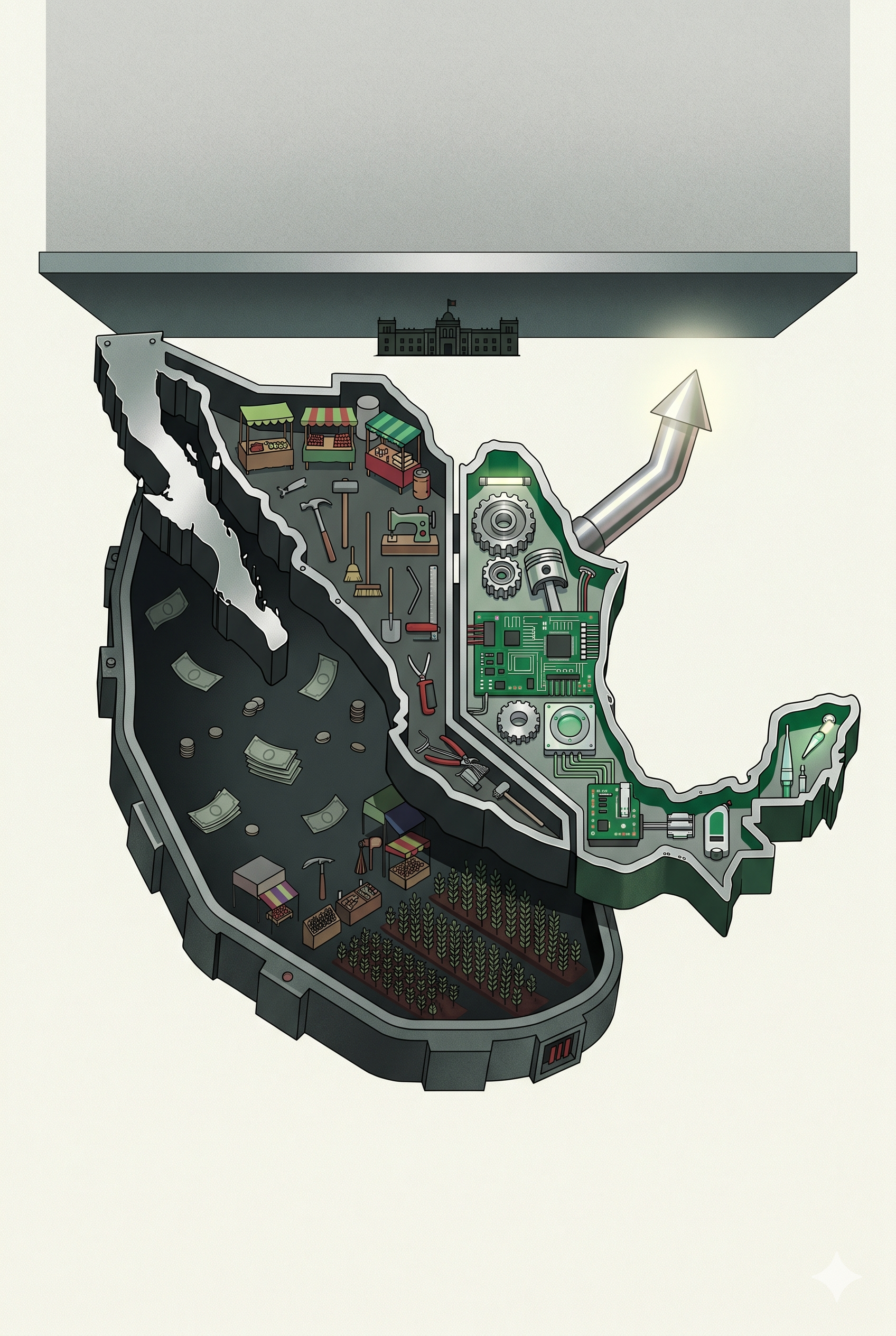
Formal economy正规经济
IMSS-registered. Taxable. Automotive, electronics, medical devices, finance, organized retail. Integrated into US supply chains via USMCA. High-productivity, export-oriented.IMSS注册。可征税。汽车、电子、医疗器械、金融、组织化零售。通过USMCA融入美国供应链。高生产率、出口导向。
Informal economy非正规经济
No IMSS. Untaxed. Invisible. Street vendors, domestic workers, subsistence farming, micro-workshops. Tax revenue: 17% of GDP vs OECD 34%. This gap sets a hard ceiling on state capacity.无IMSS。未征税。不可见。街头摊贩、家政工人、自给农业、微型作坊。税收:GDP的17% vs OECD的34%。这个缺口为国家能力设定了硬天花板。
Three serious reform experiments. Four structural forces. The reforms produced real gains. The field held.三次严肃的改革实验。四种结构性力量。改革带来了真实的收益。引力场则始终未变。
Persistent, not cyclical持续性的,非周期性的
All four structural forces predate and survive democratic transition. The 2000 alternation changed who held power. It did not alter the gravitational field. Morena's supermajority is the strongest government in 25 years and faces the same structural constraints as every predecessor.四种结构性力量先于民主转型而存在,并在转型后延续。2000年的政权交替改变了谁掌权,没有改变引力场。Morena的绝对多数是25年来最强大的政府,面临着与所有前任相同的结构性约束。
Accelerating, not stable加速中的,非稳定的
US trade dependency deepened from NAFTA to USMCA to nearshoring. Cartel territorial presence expanded from 2006 baseline. Billionaire wealth grew 10× faster than GDP. Informality has held at 55% for two decades — a floor, not a ceiling. The forces are not weakening.美国贸易依赖从NAFTA到USMCA到近岸外包不断加深。卡特尔领土覆盖从2006年基线持续扩大。亿万富翁财富增速是GDP的10倍。非正规性二十年维持55%——这是底线,不是天花板。这些力量没有减弱。
Structural, not personal结构性的,非个人性的
AMLO's "Fourth Transformation" was the most ideologically committed reform attempt since Cárdenas. Slim's wealth grew 48% during it. Homicide rates held. Tariff capitulation came in days. Personal will does not overcome structural gravity — this is a constraint on the system, not on the operator.AMLO的"第四次转型"是自卡德纳斯以来意识形态最坚定的改革尝试。斯利姆的财富在此期间增长了48%。凶杀率维持不变。关税妥协在数日内完成。个人意志无法克服结构性引力——这是对系统的约束,不是对操作者的约束。
Continuity is the default. The question is what breaks it.延续是默认状态。问题是什么打破它。
Claudia Sheinbaum took office on October 1, 2024, inheriting the most concentrated power structure since the PRI hegemony: a constitutional supermajority, 24 allied governors, a military expanding into civilian governance, and a judiciary being rebuilt through popular elections. She is not AMLO's opposite — she was his protégée, his chosen successor, and a true believer in the Fourth Transformation. The structural question is not whether she wants to change course. It is whether external forces compel changes that the movement's ideology cannot accommodate.克劳迪娅·谢因鲍姆于2024年10月1日就职,继承了自PRI霸权以来最集中的权力结构:修宪级绝对多数、24位盟友州长、扩展到民用治理的军队、以及正通过全民选举重建的司法系统。她不是AMLO的对立面——她是他的门生、钦定继任者、第四次转型的真信徒。结构性问题不是她是否想改变方向,而是外部力量是否迫使运动意识形态无法容纳的改变。
Tariff crisis (2025)关税危机(2025)
Trump's 25% tariff threat arrived within her first 100 days. Sheinbaum capitulated within a week: 10,000 GN troops to the border, fentanyl crackdown, acceptance of US demands on Chinese auto content. The capitulation confirmed the gravity thesis: rhetoric bends before trade dependency.特朗普25%关税威胁在她就任100天内到来。谢因鲍姆在一周内妥协:1万名GN部队到边境、打击芬太尼、接受美国对中国汽车内容的要求。妥协证实了引力论点:修辞在贸易依赖面前屈服。
Nearshoring window近岸外包窗口
Mexico is the primary beneficiary of US-China supply chain decoupling. FDI inflows hit $41B in 2025. Capturing this wave requires rule of law, infrastructure, and labor formalization — exactly the things Morena's institutional dismantling threatens. The nearshoring boom needs the architecture Morena is taking apart.墨西哥是美中供应链脱钩的主要受益者。2025年FDI流入达$410亿。抓住这波浪潮需要法治、基础设施和劳动力正规化——恰恰是Morena的制度摧毁所威胁的。近岸外包繁荣需要Morena正在拆除的架构。
Fiscal squeeze财政紧缩
AMLO left a 6%+ fiscal deficit and an unreformed PEMEX with $106B in debt. Sheinbaum cannot raise taxes (political suicide) or cut social programs (the movement's legitimacy base). The structural gap between 17% tax/GDP and 25%+ spending has no painless solution. A tariff recession could push the deficit to 8–9%.AMLO留下6%以上财政赤字和负债$1060亿的未改革PEMEX。谢因鲍姆无法加税(政治自杀)也无法削减社会项目(运动合法性基础)。17%税收/GDP与25%以上支出之间的结构性缺口没有无痛解决方案。关税驱动的衰退可能将赤字推至8-9%。
Mexico & Brazil — gravity versus cages墨西哥与巴西——引力 vs 制度笼子
Brazil and Mexico are Latin America's two largest economies and its two most consequential political experiments of the past decade. They fail differently. Brazil's democracy operates inside institutional cages — self-reproducing checks (coalition arithmetic, a powerful Supreme Court, a federal structure that fragments authority) that constrain governments regardless of ideology. Mexico's democracy operates in a gravitational field — structural forces that pull every government in the same direction. A government can escape a cage if it is powerful enough. No government escapes gravity. 巴西和墨西哥是拉丁美洲两个最大的经济体,也是过去十年最重要的两个政治实验。它们以不同的方式遭遇困境。巴西的民主在制度笼子内运作——自我复制的制衡(联盟算术、强大的最高法院、碎片化权威的联邦结构),无论意识形态如何都能约束政府。墨西哥的民主在引力场中运作——将每届政府拉向同一方向的结构性力量。一个足够强大的政府可以逃出笼子。没有政府能逃脱引力。
The reform tradition advanced. The gravitational field held. Neither story alone is Mexico.改革传统在推进。引力场在坚守。单一叙事都不是完整的墨西哥。
Mexico's structural story is not one of stalemate. Cárdenas redistibuted 18 million hectares — the largest land reform in the hemisphere. The EZLN built and sustained autonomous governance in Chiapas for thirty years. AMLO raised the real minimum wage by over 100%, pulled millions out of poverty, and won with a mandate no president had matched since PRI hegemony. The reforms produced real gains for real people. The structural question is not why reform failed — it did not fail entirely — but why it could not escape the gravitational field that ultimately contained it. 墨西哥的结构性故事不是僵局。卡德纳斯再分配了1800万公顷土地——半球最大的土地改革。EZLN在恰帕斯建立并维持自治治理长达三十年。AMLO将实际最低工资提高逾100%,将数百万人拉出贫困,以PRI霸权结束以来无人匹敌的授权当选。改革为真实的人带来了真实的收益。结构性问题不是改革为何失败——它并未完全失败——而是它为何无法逃脱最终将其遏制的引力场。
The limits were as real as the gains. Slim's wealth grew 48% during the Fourth Transformation. Homicide held at 35,000 per year. Export concentration to the US remained above 80% on the day AMLO left office, just as on the day he arrived. The tradition is productive and genuine. So is the gravity it operates against. Both deserve full analytical weight. 局限与收益同样真实。斯利姆的财富在第四次转型期间增长了48%。凶杀率维持在年均3.5万。AMLO离任之日对美出口集中度仍高于80%,与他到任之日无异。传统是富有成效且真实的。与之对抗的引力同样如此。两者都值得充分的分析权重。
| Force力量 | Mechanism机制 | Democracy Constrained被约束的民主维度 | Why Reform Fails改革为何失败 |
|---|---|---|---|
| US Dependency | NAFTA/USMCA integration + remittances + FDI asymmetryNAFTA/USMCA整合 + 侨汇 + FDI不对称 | Economic sovereignty经济主权 | Trade shock cost (~8% GDP) exceeds any political benefit from defiance贸易冲击成本(约8% GDP)超过任何抵制的政治收益 |
| Informality | Development model built formal contract for 40%; left 60% to market发展模式为40%建立正式契约;将60%留给市场 | State fiscal capacity国家财政能力 | Formalization cost exceeds any single sexenio's political capital正规化成本超过任何一个六年任期的政治资本 |
| Oligopoly | Privatization-era capture + regulatory agency capture + media control私有化时代俘获 + 监管机构俘获 + 媒体控制 | Economic competition经济竞争 | Monopoly holders control the legal/media environment of any reform attempt垄断持有者控制任何改革尝试的法律/媒体环境 |
| Cartel Sovereignty | PRI-era managed crime compact broken; dual state is equilibriumPRI时代管理式犯罪协约被打破;双重国家是均衡 | Territorial sovereignty领土主权 | No government has proposed a mechanism to restore the Weberian monopoly on violence没有政府提出恢复韦伯意义上暴力垄断的机制 |
Mexico's constraints are gravitational, not carceral. Brazil's democracy operates inside cages — stable, self-reproducing institutional constraints. Mexico's democracy operates in a gravitational field — persistent forces that pull every government in the same direction regardless of ideology. The political system oscillates (PRI → pluralism → Morena) but the gravitational field stays constant. 墨西哥的约束是引力性的,不是牢笼式的。巴西的民主在笼子内运作——稳定的、自我复制的制度性约束。墨西哥的民主在引力场中运作——持续的力量将每届政府拉向同一方向,不论意识形态。政治系统振荡(PRI→多元化→Morena),但引力场保持恒定。
The question for Mexico's future is whether Morena's reconcentration of power — constitutional supermajority, judicial capture, military expansion — will alter the gravitational field or merely change who sits at its center. The honest answer is uncertain. The PRI held unchecked power for 71 years and never escaped the same forces. But Mexico has also produced Cárdenas, the Zapatistas, and a real electoral left from the same social soil. Power concentration alone does not transform structural conditions. Neither, as this record shows, does reform ambition alone. Whatever comes next will be shaped by both. 墨西哥未来的问题是,Morena的权力再集中——修宪级绝对多数、司法俘获、军事扩张——是否会改变引力场,还是仅仅改变谁坐在引力场的中心。诚实的答案是不确定。PRI持有不受制衡的权力71年,从未逃脱同样的力量。但墨西哥也从同样的社会土壤中孕育出了卡德纳斯、萨帕塔运动和真实的选举左翼。单纯的权力集中不能转变结构性条件。同样,如本文所记录的,单纯的改革雄心也不能。无论下一步如何,都将由两者共同塑造。